Fort Sumter
For Sumter was also like the first battle of the civil war, with zero casualties for both sides. The fort was originally being held by Union Major Robert Anderson. Then on April 11, 1861 Confederate general Beauregard demands the surrender of Anderson. After Anderson refuses, Beauregard bombs the fort for 34 hours straight. An April 13, Anderson surrendered the fort, There was no loss of life except for one horse.
Union Troops: 80
Confederate Troops: 500
Loss of Life: 0
 |
| The fort was positioned in the middle of the harbor, which made it difficult for Union soldiers to receive supplies. |
First Battle of Bull Run
The battle of Bull Run can be regarded as the first battle in which the violence and fighting of the war turned into bloodshed and a harsh reality. The battle was fought in Virginia on July 21, 1861. Lincoln urged general McDowell, who lead the Union army in Northern Virginia, to engaged Confederate troops at Bull Run Creek, which ran along the Manassas Junction. The battle seemed like it would be an easy Union victory. However the tide changed when Confederate reinforcements arrived from Shenandoah Valley. Confederate Thomas J. Jackson, or "Stonewall" managed to counterattack. The battle turned out to be an embarrassing defeat for the Union, as Union troops broke ranks and ran in panic back to Washington. This battle also led to a Union change in command, with George McClellan replacing McDowell.
Union Soldiers Confederate Soldiers
Engaged: 28,450 32,230
Dead: 460 387
Missing/Captured:1,312 13
 |
| (Source: Wikepedia.com) The battle of Bull Run was considered the first bloody battle of the Civil War, and demonstrated to the Union that the Confederacy stood a chance at winning the war. |
Shiloh
The Battle of Shiloh took place in April of 1862, following Union victories at Fort Henry by the Tennessee River and Fort Donelson. Aware of these defeats, but also aware of Ulysses S. Grant's position, Confederate commander Albert Sydney Johnston launches a surprise attack on Union soldiers on April 6. The Union would have lost the battle had it not been for reinforcements. The battle is a Union victory after Confederate troops retreat to Corinth.
Here is a link to a video that covers the battle by History Channel: Battle of Shilol
The video provides statistics, names of commanders, information of the results of the battle, and explains troop movements.
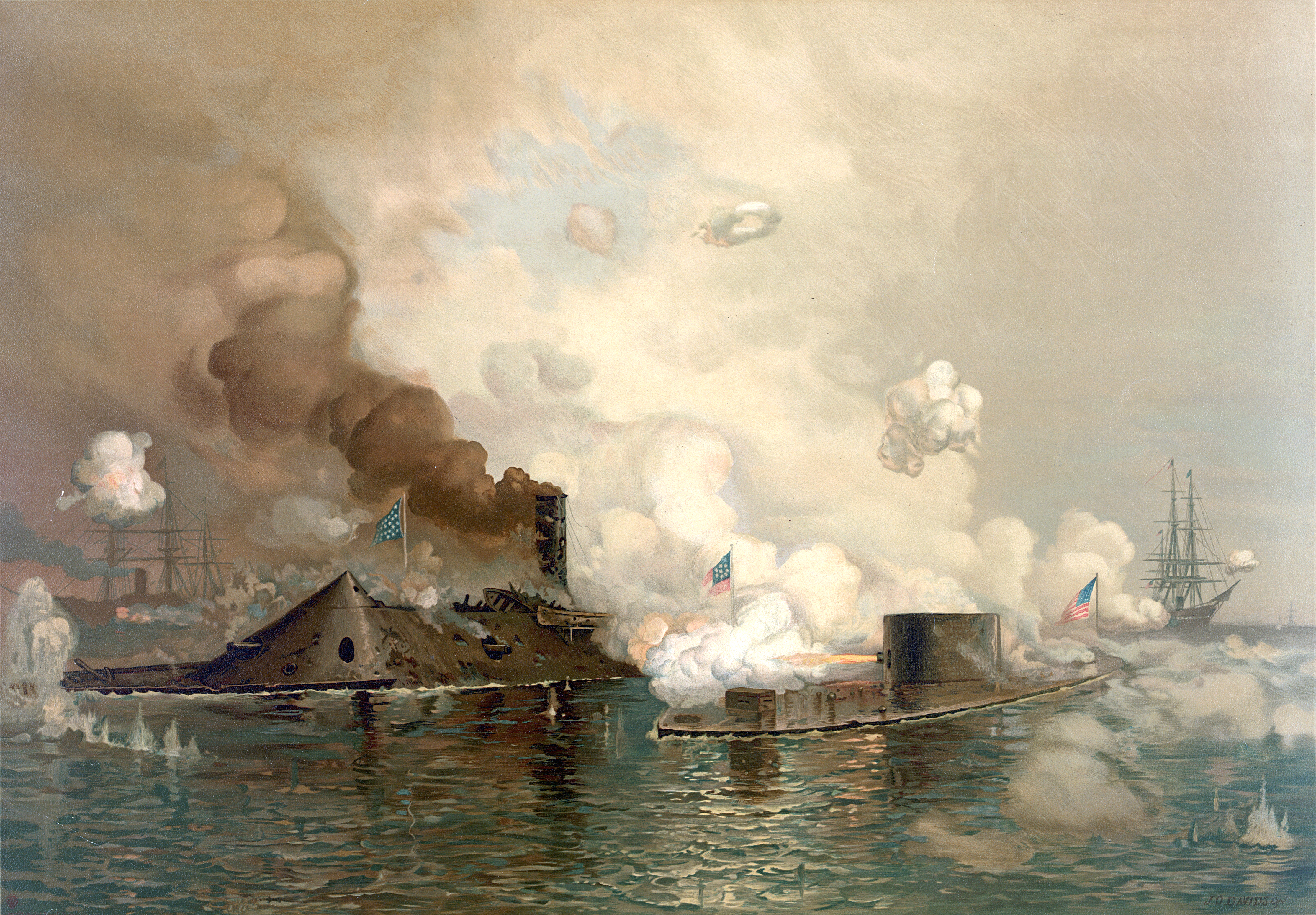
Merrimack vs. Moniter
On March 9, 1862, the last major naval battle was fought between the Union ship Moniter and the Confederate Virginia, originally named the USS Merrimac, which had previously destroyed wooden Union ships in Virginia. The battle ended as a draw and was the first to be fought between steam-powered, iron ships.
This site provides a much more detailed explanation of all of the ships involved, as well as what happened during the battle and statistics.
| (Source: Wikipedia) Having iron-clad ships turned out to be a huge advantage to both sides, since it allowed for more resistance and power. Anteitam
Following a series of victories , general Lee lead his troops north with the goal of invading Maryland and isolating Washington from the rest of the north. However, McClellan caught up to Lee near Sharpsburg to fight what would be the bloodiest battle of the war. Fought on September 17, 1862, the battle of Antietam resulted in five thousand men dead on both sides, and over 18,000 wounded. The battle resulted in a tie, but Lee retreated back to south of the Potomac.

The Battle at Antietam convinced Lincoln that McClellan had "the slows" as he failed to pursuit Lee's forces when they retreated. As a result, Lincoln promoted Ambrose E. Brunside to commander of the Army of the Potomac.
Chancellorsville
The Battle of Chancellorsville was the last humiliating defeat that the Union suffered. In May of 1863, Union general Hooker were defeated by a Confederate force half its size led by Lee. Lee's tactic involved dividing his troops at Chancellorsville, Virginia, and then sending Jackson to perform a surprise attack on the Union's right flank. Even though the Confederacy won the battle, they lost Jackson, who died due to severe wounds.
This site provides statistics, as well as a more detailed summary of the battle: http://www.civilwar.org/battlefields/chancellorsville.html?tab=facts
The battle of Chancellorsville helped bring Lee recognition in the Confederacy and boost moral.  Vicksburg
After more than a year of attempting to capture Vicksburg, Mississippi, general Grant finally crosses the river to the interior of Mississippi. After a series of Union victories and as Grant neared Vicksburg, Lee decided to go after an all-out invasion of the Northeast, which he believed would make up for the loss of Vicksburg. However, Lee's troops fell as Union soldiers had the advantage of being on home territory and not having extened supply lines. Grant to hold of Vicksburg on July fourth, which was the same day Lee retreated back to the South.
Link to a video, which provides insight on how Grant managed to capture Vicksburg and how that victory helped boost morale in the North:
Gettysburg
The Gettysburg campaign was led by Robert E Lee. as an attempt to invaded Pennsylvania and move the war away from Virginia. He also hoped that Confederate victories on Union soil would greatly lower the war support in the North. On July 3, the last and final day of the battle, Lee's 12,000 Confederate troops launched a direct attack on Cemetery Ridge. This assault is known as Pickette's charge.
Statistics: TOTAL ESTIMATED CASUALTIES 51,112 UNION CONFEDERATE 3,903 killed 3,155 killed 18,735 wounded 14,529 wounded 5,425 missing & captured 5,365 missing & captured The battle of Gettysburg led to Lincoln giving out the famous Gettysburg Address, which changed the goal of the war. The Union would now aim to end slavery. \ The address (Primary source) Source: library.loyno.edu  Sherman's March
The march was led by Union general William Tecumseh. It was one of the most aggressive assaults led by the Union. Sherman moved his troops to Atlanta and from there to the heart of Georgia. The invasion lasted from May up until September and was very successful. Sherman managed to conquer the city on the second of September. The most important effect of the battle was that it helped ensure Lincolns reelection.
Appomattox Courthouse
The battle at Appomattox courthouse was the one that set the stage for the end of the war. The battle stated off with the Confederates 9,000 troops gaining territory as they pushed back Union carvery. However, the tide quickly changed, as Union infantry began to encircle Lee's troops from the west and south. Realizing that defeat was inevitable, Lee decided to surrender the Army of Northern Virginia.
Source; Wikipedia  TOTAL ESTIMATED CASUALTIES 700 UNION 14 killed 74 wounded 64 missing & captured 158 total CONFEDERATE (Unknown) killed (Unknown) wounded (Unknown) missing & captured 500 total The victory at the Appomattox courthouse set the stage for the end of the war. Confederate troops were allowed to return home, while Union soldiers were ordered to be respectful to the Confederates. Civil War Medicine
Due to many factors, but mainly bad hygiene, disease claimed more lives during the entire war than wounds.
A small summary on how disease affected the soldiers. (Personal Media Element)
I was unable to post the video here, but this is the link: Battle Technology/Tactics
The Civil War is commonly also refereed to as the first modern war. It is the first one to be documented with photography and was a time of many military technological advances.
One of the most important innovations was the creation of a longer distance rifle. Since troops were now much more vulnerable, this lead to a change in military techniques to avoid such high fatalities. Other innovations included the use of iron clad ships, which would set a precedent for submarines, the creation of the Minie Ball.
The Minie Ball was created by French army officer Claude-Etienne Minié. It was much easier to load than the muskets since the barrel of the gun features a spiral on the inside. Once shot, the bullet would spiral down the barrel. This technique led to fewer misfires and improved range, which was 200 to 250 yards. By the end of the war, the North had made over half a billion of these bullets.
Here is a link to a video which goes over some of these innovations, including the ones mentioned above, more in detail and how they impacted the war: http://www.history.com/videos/civil-war-tech Life as a Soldier
Life as a soldier was especially hard. They spent days and months at a time away from their loved ones and often went through starvation, disease, and harsh weather.
A typical day in the life of a solider started off by walking up early in the morning to do drills. Chores included cooking, fixing their uniform, and cleaning equipment. To pass the time, they often played dominoes or poker. The average for a soldier was 25. However, as the war progressed many young men began to lie about their age. By the end of the war, solider as young as 15 years old could be seen on the battlefield. Overall, the soldiers managed to maintain their spirits up the majority of the time. They relied on religion sometimes, and comrades to keep the moral going. Summers were hard to endure mainly because of the heavy woolen uniforms.  |
Sources:
"Battle of Chancellorsville." Wikipedia. Wikimedia Foundation, n.d. Web.
Council on Foreign Relations. Council on Foreign Relations, n.d. Web. 19 Dec. 2014.
"American Civil War at EHistory.com." American Civil War at EHistory.com. N.p., n.d. Web. 04 Jan. 2014.
"American Civil War Video." History.com. A&E Television Networks, n.d. Web. 04 Jan. 2014.
"American Civil War." Kids History: Life as a Soldier During the Civil War. N.p., n.d. Web. 04 Jan. 2014.
"How The Civil War Soldiers Lived." How The Civil War Soldiers Lived. N.p., n.d. Web. 02 Jan. 2014.
"American Civil War at EHistory.com." American Civil War at EHistory.com. N.p., n.d. Web. 04 Jan. 2014.
"American Civil War Video." History.com. A&E Television Networks, n.d. Web. 04 Jan. 2014.
"American Civil War." Kids History: Life as a Soldier During the Civil War. N.p., n.d. Web. 04 Jan. 2014.
"How The Civil War Soldiers Lived." How The Civil War Soldiers Lived. N.p., n.d. Web. 02 Jan. 2014.

No comments:
Post a Comment